

MedDoctors are a Medical and Health Department Provider Institutions. Suitable For Healthcare, Medical, Doctor, Dental, Dentist, Pharmacy, Health and any Related Medical Care Field.
14D Street Brooklyn,
New York.


MBBS (KEMH), MD Medicine (LTMMC)
DM Neurology (AIMS, New Delhi), FINR (Stroke & Neurointervention)
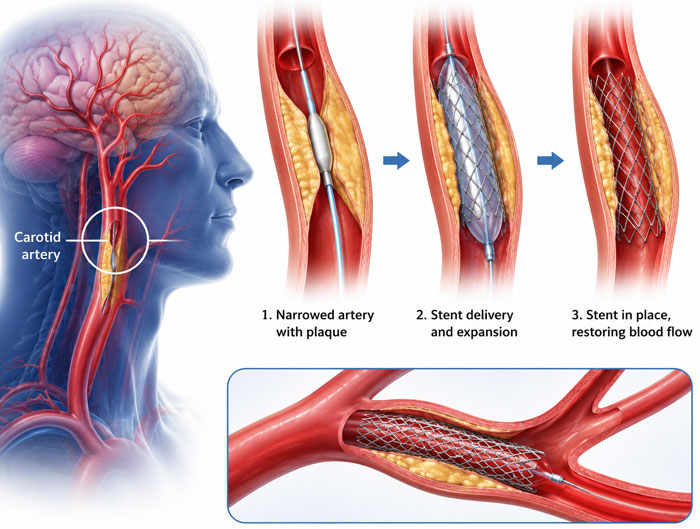
Carotid and intracranial artery narrowing can reduce blood flow to the brain and increase the risk of stroke or transient ischemic attack (TIA). Stenting is a minimally invasive treatment that can help open a narrowed artery and improve blood flow in carefully selected patients. Early evaluation and appropriate treatment can help reduce the risk of future stroke and other complications.
Dr. Abutahir Shaikh specializes in the diagnosis and treatment of cerebrovascular conditions. He provides advanced evaluation and minimally invasive neurointerventional treatment for carotid artery stenosis, intracranial artery narrowing, stroke, and other conditions affecting blood flow to the brain.
Carotid artery stenosis is a narrowing of one or both carotid arteries, the major blood vessels that carry blood from the heart to the brain. The narrowing is commonly caused by the buildup of fatty deposits called plaque inside the artery.
When a carotid artery becomes significantly narrowed, blood flow to the brain may be reduced. Plaque or blood clots can also travel toward the brain and cause a TIA or stroke. Treatment depends on the severity of narrowing, symptoms, overall health, and individual stroke risk.
Intracranial artery stenosis refers to narrowing of an artery located inside the brain. This narrowing can reduce blood flow to areas of the brain and may increase the risk of TIA or ischemic stroke.
Intracranial artery narrowing may be related to atherosclerosis or other blood vessel conditions. Careful neurological and vascular evaluation is important to determine the most suitable treatment approach for each patient.
Some people with artery narrowing may not have noticeable symptoms. However, reduced blood flow or a TIA may cause sudden neurological symptoms. Common warning signs include:
Sudden weakness, speech difficulty, vision loss, facial drooping, or other stroke-like symptoms require immediate emergency medical attention.
Carotid angioplasty and stenting may be considered for selected patients with significant carotid artery narrowing, particularly when carotid surgery may not be the most suitable option. The decision is based on the severity and location of the narrowing, symptoms, previous treatment, overall health, and the patient's risk of stroke.
In some patients, carotid endarterectomy may be preferred. A specialist evaluates the individual condition and discusses the most appropriate treatment option.
Intracranial stenting may be considered in selected patients with significant narrowing of an artery inside the brain. Because intracranial blood vessels are delicate and treatment carries potential risks, careful evaluation is required before considering an endovascular procedure.
The treatment plan may depend on the severity and location of the narrowing, symptoms, previous stroke or TIA, response to medical treatment, and the patient's overall condition.
Detailed vascular and neurological evaluation helps identify the location and severity of artery narrowing and assess the risk of stroke. Diagnostic tests may include:
Carotid ultrasound can assess blood flow and narrowing in the carotid arteries, while CTA and MRA provide detailed images of blood vessels. Cerebral angiography or DSA may be performed when detailed information about the blood vessels is needed for treatment planning.
Carotid angioplasty and stenting is a minimally invasive procedure used to widen a narrowed carotid artery and help improve blood flow to the brain. A thin catheter is guided through a blood vessel to the narrowed area under X-ray guidance.
A small balloon may be used to widen the narrowed section, followed by placement of a small mesh stent that helps keep the artery open. In many procedures, an embolic protection device may be used to help reduce the risk of debris travelling toward the brain.
Intracranial artery stenting is an endovascular procedure used in selected cases of significant narrowing within the arteries of the brain. A catheter is carefully guided through the blood vessels to reach the narrowed artery.
Depending on the patient's condition and the treatment plan, angioplasty and stent placement may be used to improve blood flow through the affected artery. Intracranial stenting is considered only after detailed assessment because the risks and benefits can vary significantly between patients.
For appropriately selected patients, endovascular stenting may help improve blood flow through a narrowed artery and may form part of a strategy to reduce stroke risk. Potential benefits depend on the underlying condition and the patient's individual risk factors.
Carotid stenting is generally performed in a specialized catheterization or angiography setting. The patient is monitored throughout the procedure, and local anesthesia and medication to help with relaxation may be used depending on the case.
A catheter is inserted through a blood vessel, commonly through the groin or another suitable access point, and guided toward the narrowed artery. Contrast imaging is used to visualize the blood vessel. The narrowed area is treated with angioplasty and a stent when indicated.
After the procedure, the patient is monitored for neurological changes, blood pressure, and the catheter access site. Follow-up imaging may be recommended to assess the treated artery.
Like any medical procedure, carotid and intracranial stenting can have risks. These may include stroke or TIA, bleeding, blood clot formation, artery narrowing again, or complications at the catheter insertion site. The risks vary depending on the procedure and the patient's health.
After stenting, patients may need prescribed medicines, regular medical follow-up, and imaging as advised by the treating specialist. Lifestyle measures such as controlling blood pressure and cholesterol, avoiding smoking, maintaining a healthy weight, and regular physical activity can also support long-term vascular health.
Stenting is only one part of long-term stroke prevention. Managing the underlying risk factors is important to protect blood vessel health and reduce the risk of future stroke.
If you have been diagnosed with carotid artery narrowing, intracranial artery stenosis, or have experienced a TIA or stroke, a detailed neurological and vascular evaluation can help determine the most appropriate treatment.
Consult Dr. Abutahir Shaikh for expert evaluation and advanced neurointerventional treatment for carotid artery stenosis, intracranial artery narrowing, stroke prevention, and other cerebrovascular conditions.
Find answers to common questions about carotid and intracranial stenting, artery narrowing, and stroke prevention.

